
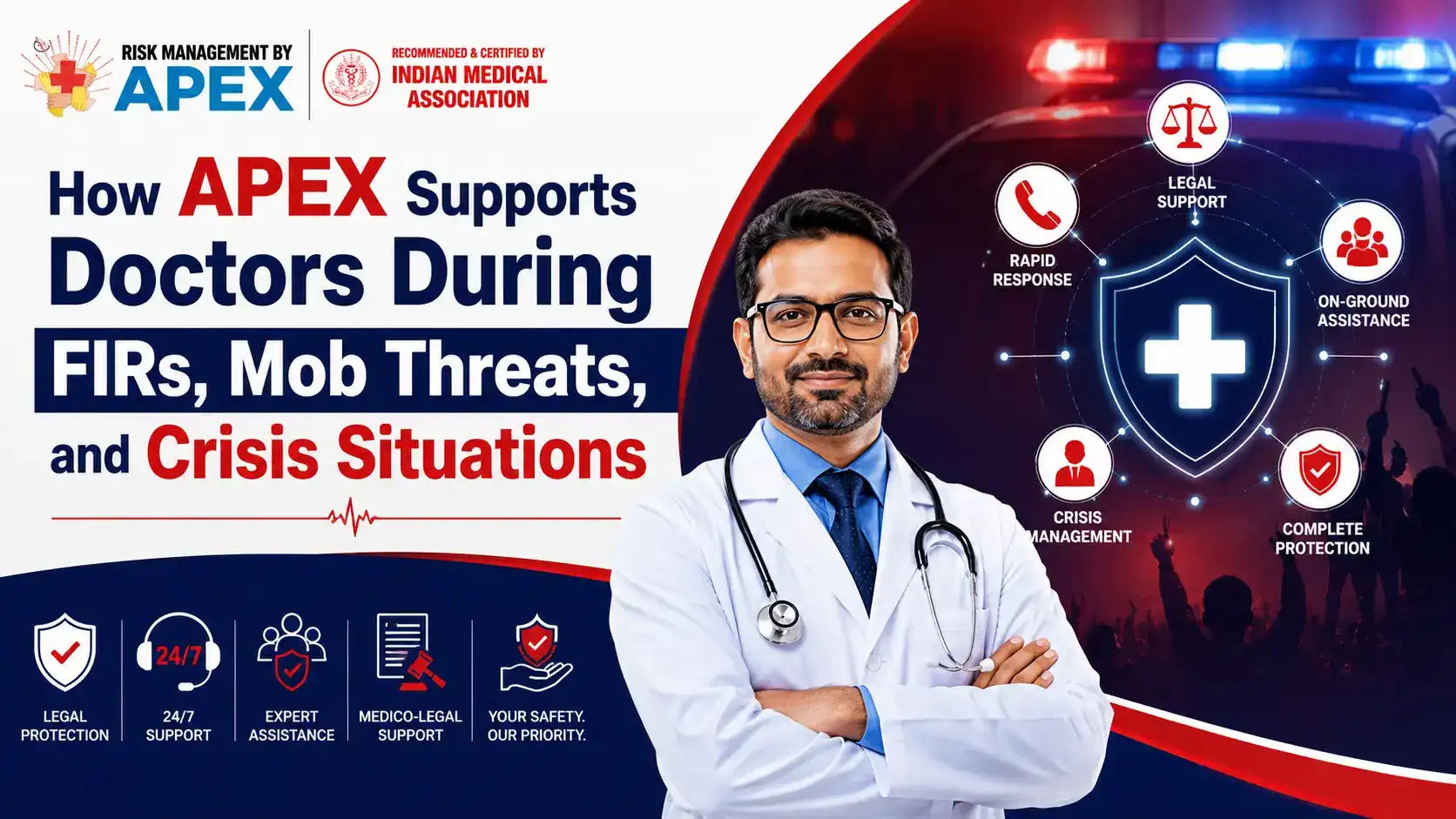
“A medical crisis rarely waits for the paperwork to begin.”
A complication occurs. Relatives are distressed. Questions are raised. Before the clinical team has fully understood what happened, someone mentions an FIR or calls the police. In a hospital setting, tensions can rise quickly.
For a doctor, this is a very different kind of emergency.
Professional indemnity insurance remains important, but a crisis may require medico-legal guidance before a conventional indemnity claim even begins. The immediate need is often practical: what should the doctor say, what records should be preserved, and who should coordinate the response?
An FIR Is Serious, But It Is Not a Finding of Guilt
An FIR records information about an alleged cognizable offence. It does not, by itself, establish that a doctor has committed an offence.
India’s current criminal law includes Section 106 of the Bharatiya Nyaya Sanhita, 2023, which addresses causing death by negligence and provides a specific provision for a registered medical practitioner performing a medical procedure. The provision has been in force since July 1, 2024.
The Supreme Court’s landmark judgment in Jacob Mathew v. State of Punjab, decided on August 5, 2005, remains important in understanding criminal medical negligence. The Court stressed that criminal liability requires a much higher degree of negligence than ordinary civil negligence. The case itself arose from an FIR registered after the death of a patient at CMC Hospital, Ludhiana.
The practical lesson is straightforward. Doctors should take a criminal complaint seriously, but should also avoid panic or hurried responses without appropriate legal guidance.
What Happens When a Hospital Suddenly Becomes a Crisis Scene?
Consider an unexpected OT death or a serious complication following emergency treatment.
The family may understandably demand answers. Police may arrive. Hospital staff may be questioned. Medical records may become relevant. Someone may post allegations online.
The doctor now has several responsibilities at once.
Clinical records should be preserved. Communication should remain professional. Statements should be accurate and carefully considered. The hospital administration should be involved where appropriate. Personal confrontation should be avoided, particularly when tensions are high.
The Supreme Court has specifically recognized the need for safeguards when doctors face criminal prosecution for alleged negligence. Its guidance in Jacob Mathew emphasizes the importance of competent medical opinion and caution in criminal proceedings against medical professionals.
Where Professional Indemnity Fits In
Professional indemnity is an important financial protection layer, but doctors should not assume that every policy covers criminal proceedings or every crisis-related expense.
Coverage depends on the policy wording, circumstances, and applicable terms.
That distinction matters. Professional indemnity for doctors may address covered professional liability and associated legal costs, while a police complaint, criminal investigation, hospital unrest, regulatory issue, or reputation concern may require separate medico-legal assistance.
Doctors should therefore understand exactly what their policy covers and what support is available outside the insurance claim itself.
Where APEX Goes Beyond the Policy
APEX Risk Management and Professional Indemnity Services approaches these situations through a broader risk management model.
Its dedicated medico-legal panel includes professionals with medical and legal understanding, including MBBS plus LLB expertise. The objective is to provide doctors with practical guidance when a situation is developing, rather than waiting for a compensation claim to take shape.
Support can include:
- Early medico-legal guidance
- Assistance with documentation and records
- Guidance during police or criminal complaints
- Hospital-level coordination
- Claim assistance where applicable
- Defence and resolution support
- Risk management advice
APEX also provides Pan India support and uses its DreamAp digital platform for coordination and communication.
The important distinction is that medico-legal services and professional indemnity insurance serve related but different purposes. One addresses professional and financial protection according to policy terms. The other helps doctors navigate the practical legal situation surrounding an incident.
A Simple Question Doctors Should Ask
Before choosing professional indemnity insurance, doctors should ask more than, “How much coverage do I have?”
Ask:
“If I receive an FIR tomorrow, who do I call?”
The answer should be clear before a crisis occurs.
For doctors and hospitals, preparedness means having financial protection, appropriate legal advice, reliable documentation, and a coordinated response framework.
A policy can protect your finances. The right medico-legal ecosystem helps protect you through the crisis itself.